عربي


Shaving every morning, waxing every few weeks, dealing with ingrown hairs and irritated skin: for many people, hair removal becomes a routine they would happily give up. It is one of the main reasons laser hair removal has become so popular. The idea is simple. Instead of removing the hair again and again, a laser treats the hair follicle itself, so less hair grows back over time.
But the questions come quickly. Is it safe? Does it work on my skin tone? How many sessions will I need? Is it really permanent? And how do I choose a clinic when there are so many to pick from? The answers depend on your skin, your hair, and who performs the treatment.
This guide explains how laser hair removal works, what safety checks matter, how many sessions most people need, what results to expect, and how to prepare. If you are considering laser hair removal in Qatar, it should help you ask the right questions before you book.
Book a Dermatology & Laser Consultation
At American Hospital Clinics Doha today.
Quick Answer
Laser hair removal uses concentrated light to heat and damage the hair follicle, which reduces hair growth. Most people need about 6 to 8 sessions, spaced several weeks apart, because hair grows in cycles and the laser only works on hairs in the active growth phase. Results are best described as long-lasting hair reduction rather than a guarantee of permanent removal, and occasional maintenance sessions may be needed. Safety depends on the right laser for your skin type, a proper assessment, and a trained practitioner under medical supervision. Laser hair removal in Qatar should begin with a consultation, not a package sold at the counter.
Key Takeaways
- Laser hair removal reduces hair growth, and results often last a long time, but it is not guaranteed to be permanent
- Most people need 6 to 8 sessions, and some areas or hormonal conditions need more
- Sessions are spaced about 4 to 8 weeks apart, depending on the body area
- Dark, coarse hair on lighter skin responds best, but modern lasers can treat many skin tones safely when properly chosen
- White, grey, and very light blonde hair respond poorly to laser
- Sun exposure and tanning before or after treatment raise the risk of burns and pigment changes
- A medical assessment and a patch test help reduce risk
- Choosing a clinic with medical oversight and well-maintained equipment matters as much as the laser itself
How Laser Hair Removal Works
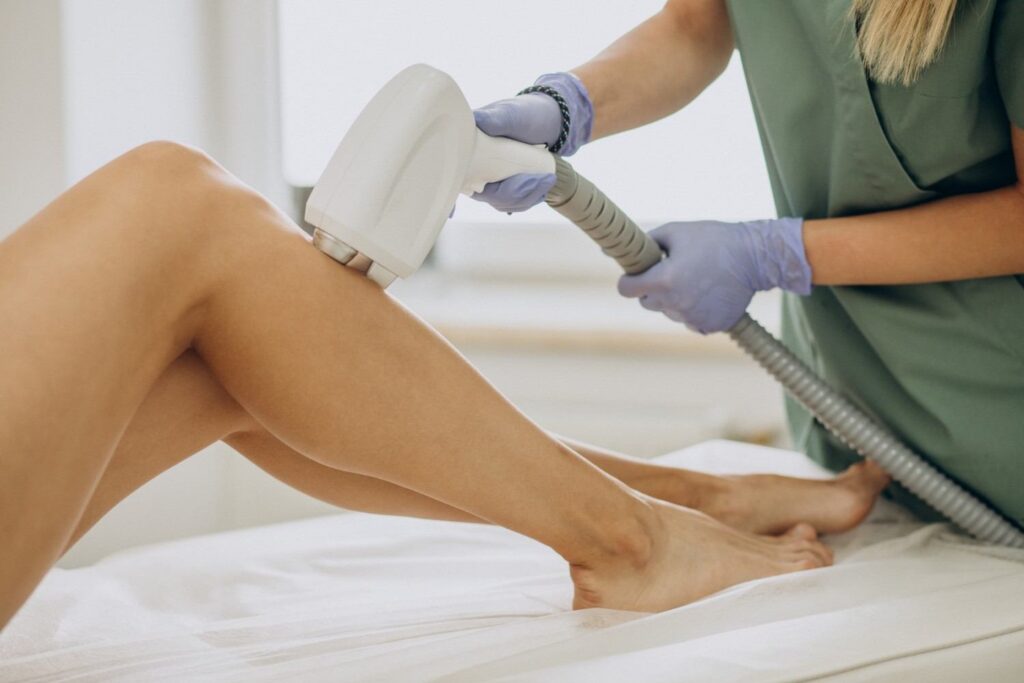
The laser emits light that is absorbed by the dark pigment (melanin) in the hair. The light turns to heat, which damages the follicle so it grows thinner, finer, or stops producing hair. Because only hairs in the active growth phase are affected, and each hair is at a different stage at any one time, a single session cannot treat them all. That is why repeat treatments are needed.
Different laser types suit different skin tones:
- Alexandrite: often used for lighter to medium skin tones
- Diode: works on a range of skin tones, and is commonly used for larger areas
- Nd:YAG: a longer wavelength that penetrates deeper and bypasses more of the skin’s surface pigment, making it a common choice for darker skin tones
- Intense pulsed light (IPL): not a true laser, but a broad-spectrum light device sometimes used for hair reduction
Your practitioner will choose the device and settings according to your skin type, hair colour and thickness, and the body area.
Is Laser Hair Removal Safe?
For most healthy adults, laser hair removal is considered a safe cosmetic treatment when it is carried out properly. The main risks come from the wrong laser or settings for your skin, treating tanned skin, or inexperienced operators. Safety depends on:
- A proper assessment of your skin type, medical history, medicines, and hair
- A suitable device and settings for your skin tone
- A patch test in a small area before full treatment, where appropriate
- Eye protection for you and the practitioner
- Skin cooling during treatment to protect the surface
- A trained practitioner working with medical oversight, ideally in a dermatology setting
- Clear aftercare advice
Possible side effects
- Redness and mild swelling around the follicles, which usually settles within hours to a couple of days
- A warm, stinging, or snapping sensation during the pulses
- Temporary dryness or sensitivity
- Changes in skin colour, either darker (hyperpigmentation) or lighter (hypopigmentation), which are more likely with tanned skin or an unsuitable laser setting and are usually temporary but can occasionally persist
- Blisters, burns, or crusting, which are uncommon but more likely if sun protection is poor or settings are too high
- Rarely, scarring or an increase in hair growth in nearby areas (paradoxical hypertrichosis)
Choosing an experienced provider and following preparation and aftercare instructions lowers these risks.
How Many Sessions Will You Need?
Most people need about 6 to 8 sessions for good results, though it varies:
Area | Typical spacing | Typical number of sessions |
Face and upper lip | 4 to 6 weeks | 6 to 8 or more |
Underarms | 6 to 8 weeks | 6 to 8 |
Bikini line | 6 to 8 weeks | 6 to 8 |
Arms and legs | 8 weeks | 6 to 8 |
Back and chest | 8 weeks | 6 to 8 |
Facial hair grows faster and in more cycles, so shorter intervals are used. Body areas tend to need longer gaps.
Some people need extra sessions, including those with:
- Hormonal conditions such as polycystic ovary syndrome (PCOS), where new hair can keep appearing
- Fine or light-coloured hair
- Thick, dense hair in hormonally influenced areas such as the chin and jawline
- Darker skin, where lower energy settings are used to protect the skin, so results may build more slowly
After the first course, many people need an occasional top-up session, perhaps once or twice a year, to treat hairs that appear later.
What Results Can You Expect?
- After the first session or two: hair may grow more slowly and look finer. Treated hairs can shed over the following one to three weeks, which can look like new growth but is the hair falling out
- Midway through the course: noticeable thinning and fewer hairs, with smoother skin
- After a full course: most people see a significant reduction, often 70 to 90 percent in suitable cases, though this varies
- Long term: many people stay smooth for months or years, with occasional touch-ups
Results depend on hair colour, skin tone, hormones, the area treated, and how well you follow the schedule. A good practitioner will give you a realistic estimate at your consultation, not a promise of total removal.
Who’s a Good Candidate?
Laser hair removal tends to suit:
- Adults with dark, coarse hair, especially on lighter skin
- People with darker skin, when treated with an appropriate laser by an experienced practitioner
- Those troubled by ingrown hairs, razor bumps, or repeated shaving and waxing
- People who want long-term reduction on the face, underarms, bikini area, arms, legs, or back
It works poorly on:
- White, grey, red, or very light blonde hair, which has little pigment for the laser to target
Who Needs Extra Care or Should Wait
Tell your practitioner if any of these apply, as treatment may need to be delayed, adjusted, or avoided:
- Pregnancy or breastfeeding. Many clinics advise postponing, as safety data is limited
- A recent suntan, or plans for sun exposure or travel to a sunny destination
- Active skin infection, cold sores, open wounds, or eczema or other skin conditions in the area
- A history of keloid or raised scarring
- Medicines that make the skin sensitive to light, such as certain antibiotics and some acne treatments. Recent use of isotretinoin should be discussed with your doctor
- A history of conditions triggered by light, or of skin cancer in the area
- Tattoos or moles in the treatment area, which need to be avoided or covered
- Hormonal conditions, which may call for a medical check and a longer plan
Book your appointment
Limited slots available this month — Reserve yours now
BOOK YOUR DERMATOLOGY & LASER CONSULTATION NOW
How to Prepare
- Avoid sun and tanning for at least two to four weeks before treatment, and use sunscreen on exposed areas. Sunless tanning products also count
- Do not wax, pluck, thread, or use epilators for about four to six weeks before, because the laser needs the hair root to be present. Shaving is fine and usually required
- Shave the area a day before, or as instructed, so the laser targets the follicle rather than hair above the skin
- Skip creams, perfume, and deodorant on the area on the day
- Tell your practitioner about all medicines, creams, and skin conditions
- Avoid hair removal creams just before your session, unless your clinic says otherwise
What Happens During a Session
- Consultation and assessment: your skin type, hair, medical history, and goals are reviewed, and a plan is discussed
- Preparation: the area is cleaned, and you and the practitioner wear eye protection
- Settings and test pulse: the laser is adjusted for you, and a test pulse is used
- Treatment: the laser is passed over the area in pulses, with cooling to protect the skin. Small areas such as the upper lip can take minutes, while legs or the back can take up to an hour
- Aftercare: a soothing product may be applied, and you will be given instructions
Most people describe the sensation as a quick snap or sting, like a rubber band flick. Numbing cream can be used for sensitive areas if your practitioner advises it.
Aftercare: What Helps
- Use cool compresses or a soothing, fragrance-free moisturiser if the skin feels warm
- Avoid hot baths, saunas, steam rooms, heavy exercise, and swimming pools for 24 to 48 hours, or as advised
- Protect the skin from the sun with broad-spectrum sunscreen and clothing, and avoid tanning for several weeks
- Do not scrub, pick, or use harsh products on the area
- Shave, rather than wax or pluck, between sessions
- Do not be alarmed by shedding, which can look like fresh growth for one to three weeks
- Keep to your recommended schedule, as missing sessions affects results
Contact your clinic if you have blistering, increasing pain, signs of infection such as pus or spreading redness, or marked colour changes.
Choosing a Clinic for Laser Hair Removal in Qatar
Not all laser services are the same. Before you book, ask:
- Is treatment carried out by trained staff with medical or dermatology oversight?
- Will I be assessed before treatment, and will a patch test be done?
- Which type of laser is used, and is it suitable for my skin tone?
- How many sessions are likely to be needed, and what happens if I need more?
- What is the aftercare, and who do I contact if I have a problem?
- Can I request a practitioner of a particular gender for privacy?
Be cautious of very cheap offers, guaranteed “permanent” results, or pressure to pay for a large package without a proper consultation.
Laser Hair Removal in Qatar: Local Factors
Sun exposure is the main local consideration. Strong sunshine for much of the year, and the habit of tanning or spending time outdoors, raise the risk of pigment changes after laser. Many people choose to start a course in cooler months, when it is easier to stay out of the sun and keep treated skin covered, though treatment can be done year-round with strict sun protection. If you are planning to travel to a sunny place, plan your sessions around it.
Ramadan is another point to plan. Laser hair removal is not a medical procedure that affects fasting, but some people prefer to schedule sessions in the evening or avoid the hottest part of the day. Privacy and comfort also matter to many patients, so do not hesitate to ask about your options when booking.
What a Typical Journey Looks Like
Initial Consultation
Your practitioner reviews your skin, hair, medical history, and goals, and explains what laser hair removal can and cannot do for you.
Treatment Sessions
A course of sessions is planned, with settings adjusted as your hair responds.
Follow-Up
Progress is reviewed, and maintenance sessions are advised as needed.
How American Hospital Qatar’s Dermatology & Laser Department Can Help
At American Hospital Qatar, our Dermatology & Laser Department offers assessment and treatment for adults who want long-term hair reduction, with medical oversight and a plan that fits your skin.
- Experienced Dermatology Team: assessment of your skin type, hair, and medical history
- Suitable Laser Selection: guidance on the right device and settings for your skin tone
- Personalized Treatment Plans: a realistic number of sessions and spacing for each area
- Clear Aftercare Guidance: advice on sun protection and caring for treated skin
- Upfront Information: our team explains the expected sessions and costs before you begin
Frequently Asked Questions
Is laser hair removal permanent?
How many laser hair removal sessions do I need?
Is laser hair removal safe for darker skin?
Does laser hair removal hurt?
Can I shave between sessions?
Can I get laser hair removal if I am tanned?
Does laser work on white or blonde hair?
Is laser hair removal safe during pregnancy?
Conclusion
Laser hair removal can be a practical way to cut down on shaving, waxing, and ingrown hairs, but the best results come from realistic expectations and the right setup. A proper assessment, a laser suited to your skin, a full course of sessions, and good sun protection all matter.
If you are weighing up laser hair removal in Qatar, start with a consultation so you can ask your questions and understand what to expect for your skin and hair. American Hospital Qatar’s Dermatology & Laser Department is ready to help. Call +974 44421999 or visit americanhospital.qa to book a consultation.