عربي
عربي


Everyone Wants a Brighter Smile. Not Everyone Gets the Same Results.
Walk through any pharmacy in Doha and you’ll find an entire shelf dedicated to whitening: strips, pens, toothpastes, LED kits, trays. Browse Instagram and you’ll see influencers holding up charcoal powders and oil-pulling jars promising professional-level results.
Then there’s professional teeth whitening — done in a dental clinic, by a qualified dentist, in under an hour.
The question is: what actually works? And is the price difference between clinic and at-home worth it?
Here’s the honest answer from the dental team at American Hospital Clinics Doha.
Why Do Teeth Stain in the First Place?
Why Do Teeth Stain in the First Place?
Before comparing whitening methods, it helps to understand what you’re actually treating. Tooth discolouration comes in two types:
Extrinsic Staining
Staining on the outer surface of the tooth caused by coffee, tea, red wine, tobacco, and coloured foods. This is what most whitening products target — and the type most people have.
Intrinsic Staining
Discolouration that comes from within the tooth structure — caused by certain antibiotics (tetracycline), trauma, fluorosis, or ageing. This type is far harder to treat and may not respond to standard whitening at all. A dentist will assess which type you have before recommending any treatment.
Professional Teeth Whitening at a Dental Clinic: What Actually Happens?
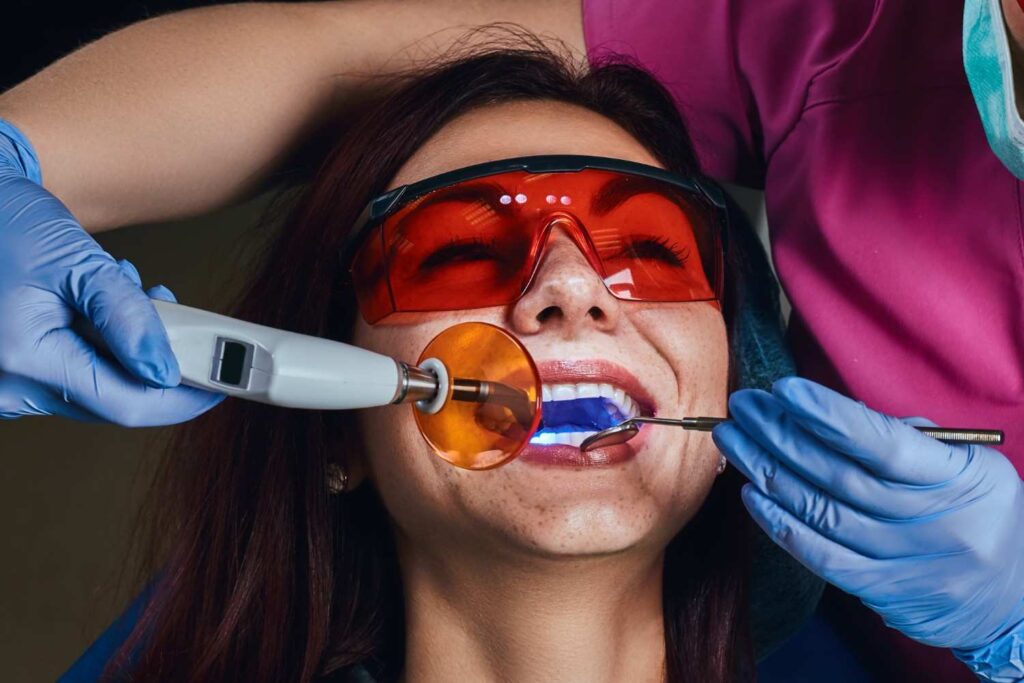
Clinical teeth whitening uses a high-concentration hydrogen peroxide or carbamide peroxide gel — far stronger than anything available over the counter — applied directly to the teeth under controlled conditions.
In-Chair Whitening (The One-Session Option)
– A protective barrier is applied to your gums before any gel touches your teeth
– Whitening gel is applied to the tooth surface in controlled amounts
– In some systems, an LED or laser light is used to activate the gel
– The process takes 45 to 90 minutes
– Most patients see 4 to 8 shades of improvement in a single session
Take-Home Trays from a Dentist (The Sustained-Results Option)
– Custom-fitted trays are made from an impression of your teeth
– Dentist-prescribed whitening gel is used at home — at a lower concentration, worn over 1 to 2 weeks
– Results are comparable to in-chair whitening but develop more gradually
– Trays can be reused for maintenance whitening in future
Important: Over-the-counter whitening products contain a maximum of 0.1% hydrogen peroxide in Qatar. Professional dental whitening uses up to 40%. That gap in concentration is why the results are incomparable.
At-Home Whitening Kits: What Works and What Doesn’t
Product | How It Works | Effectiveness | Safety Level |
Whitening Toothpaste | Abrasives polish surface stains | Low — surface only | Generally safe |
Whitening Strips | Low-conc peroxide strips | Low to moderate | Can cause sensitivity |
LED Whitening Kits | Light activates whitening gel | Low — gel is very weak | Variable |
Charcoal Powder | Abrasive surface scrubbing | Very low, can damage enamel | Not recommended |
Dentist Take-Home Trays | Custom-fit, prescribed gel | High | Safe with dentist guidance |
In-Chair Clinic Whitening | High-conc gel, controlled conditions | Highest | Safe with professional oversight |
What Causes Teeth Whitening to Go Wrong?
Most whitening problems come from unsupervised use of products that aren’t appropriate for a patient’s teeth. Common issues include:
– Severe sensitivity lasting days after treatment — usually from over-application
– Uneven whitening — patches of lighter and darker enamel
– Gum irritation or chemical burns from poorly applied gel
– No improvement — because the staining is intrinsic and doesn’t respond to peroxide
– Temporary results that fade within weeks due to low gel concentration
At American Hospital Clinics Doha, your dentist assesses your teeth before any whitening is recommended — checking enamel health, identifying any cavities or gum problems, and confirming which type of staining you have.
Who Is Not a Candidate for Teeth Whitening?
– Patients with untreated cavities or active gum disease — these must be addressed first
– Patients with dental crowns, veneers, or bonding — whitening does not change the colour of restorations
– Pregnant or breastfeeding women — whitening is deferred until after
– Children under 16 — teeth are still developing
– Patients with severe intrinsic staining — veneers or bonding may be a better solution
REVIEWED & ENDORSED BY
Dental Department | American Hospital Clinics Doha
"Professional teeth whitening, when done correctly, is one of the safest and most effective cosmetic dental procedures available. The key is a proper assessment first — because whitening is not one-size-fits-all, and the wrong approach can damage enamel or produce uneven results that are hard to correct."
BOOK YOUR DENTAL CONSULTATION
Limited slots available this month — Reserve yours now
What Our Patients Say
— Nadia
— Tariq
— Aisha
Before and After Your Whitening Session: What to Know
Before Your Session:
– Have a dental check-up to ensure your teeth are healthy enough for whitening
– Avoid heavily staining food and drinks (coffee, tea, red wine) for 48 hours before
– If you have sensitive teeth, mention this to your dentist — sensitivity management options are available
After Your Session:
– Avoid staining foods and drinks for at least 48 hours — this is your ‘white period’
– Sensitivity is normal for 24 to 48 hours after treatment — it will pass
– Maintain results with good brushing habits and regular dental hygiene visits
– Consider a maintenance top-up every 12 to 18 months
Frequently Asked Questions
Is teeth whitening safe?
How long does teeth whitening last?
Will whitening damage my enamel?
What is the best teeth whitening method in Doha?
Can I whiten my teeth if I have crowns or veneers?
BOOK YOUR TEETH WHITENING CONSULTATION NOW
Whiter teeth, brighter confidence
C Ring Road, Al Muntazah St, Near Al Andalus Petrol Station, Doha, Qatar