عربي
عربي


The Importance of Skin Cancer Awareness During High UV Seasons
Skin cancer is the world’s most common cancer. It is also among the most preventable—and when detected early, it is highly treatable. In Qatar, where UV radiation reaches extreme levels and residents accumulate significant sun exposure simply by living here, skin cancer awareness is not optional—it is essential. At American Hospital Clinics Doha, our dermatology specialists encourage regular skin checks and preventive care to help reduce the risk of skin cancer through early detection and education.
Many people in Qatar underestimate this risk. They may believe skin cancer is “a Western disease,” that their skin tone provides complete protection, or that the risk only exists during prolonged outdoor activities. These assumptions are incorrect. In Qatar’s high UV environment, every resident—regardless of skin tone, occupation, or lifestyle—can benefit from understanding skin cancer, recognising its warning signs, and taking protective action. American Hospital Clinics Doha is committed to helping patients protect their skin with expert dermatology care, skin cancer screenings, and personalised prevention advice.
Book your skin cancer screening
At American Hospital Clinics Doha today.
Quick Answer
Skin cancer is caused primarily by UV radiation from the sun. In Qatar, with its extreme year-round UV index, residents face significant cumulative UV exposure and elevated skin cancer risk. The three main types — basal cell carcinoma, squamous cell carcinoma, and melanoma — are all associated with UV exposure. Early detection dramatically improves treatment outcomes. Annual skin checks, daily SPF 50 sunscreen, and knowing the ABCDE warning signs are the most important protective steps for residents of Qatar.
Key Takeaways
- Skin cancer is the world’s most common cancer and is strongly linked to UV radiation.
- All skin types can develop skin cancer — darker skin is not immune.
- Qatar’s extreme UV index creates a year-round elevated risk for skin cancer development.
- The three main skin cancers (basal cell carcinoma, squamous cell carcinoma, melanoma) all have different appearances and behaviours, but all benefit from early detection.
- Regular professional skin checks and daily sun protection are the most important protective measures.
- Most skin cancers, when caught early, are highly treatable.
Understanding Skin Cancer
Skin cancer occurs when UV radiation damages the DNA in skin cells, causing them to replicate abnormally and form tumours. There are three main types:
Basal Cell Carcinoma (BCC): The most common type. Tends to appear on sun-exposed areas as a pearly or flesh-coloured bump, a flat scar-like lesion, or a pink growth. BCC rarely spreads to other parts of the body but can cause significant local damage if left untreated.
Squamous Cell Carcinoma (SCC): The second most common type. Often appears as a firm, red nodule or a rough, scaly patch on sun-exposed skin. SCC can spread if not treated. Actinic keratoses (pre-cancerous rough patches) are SCC precursors and should be assessed by a dermatologist.
Melanoma: The most dangerous type of skin cancer. It can arise from an existing mole or as a new lesion and has the potential to spread to other organs if not caught early. Melanoma risk is particularly associated with episodes of severe sunburn and with cumulative UV exposure.
Common Causes in Qatar’s Context
- Cumulative daily UV exposure over years of living in Qatar’s intense sun
- Repeated sunburns, particularly in childhood and early adulthood
- Not using sunscreen consistently
- Occupational outdoor exposure without adequate protection
- Family history of skin cancer
Warning Signs to Watch For — The ABCDE Rule
Check all moles, spots, and skin lesions regularly using the ABCDE rule:
- A — Asymmetry: One half of the mole or spot looks different from the other
- B — Border: Edges are irregular, ragged, notched, or blurred
- C — Colour: Multiple shades — brown, black, red, white, or blue — within the same lesion
- D — Diameter: Larger than 6mm (the size of a pencil eraser), though melanomas can be smaller
- E — Evolving: Any change in size, shape, colour, or new symptoms such as bleeding, itching, or crusting
Also watch for:
- Any new skin growth that bleeds easily
- Sores that do not heal within a few weeks
- Rough or scaly patches that persist despite moisturising
Book your appointment
Limited slots available this month — Reserve yours now
Book your skin cancer screening at American Hospital Clinics Doha today.
Who Is Most at Risk in Qatar?
- All residents regardless of skin tone — though fair skin carries higher risk
- People with a personal or family history of skin cancer
- Outdoor workers with prolonged daily sun exposure
- Those with many moles or unusual (atypical) moles
- People who have experienced significant sunburn, especially in childhood
- Long-term residents of Qatar who have accumulated years of high UV exposure
Why It Matters in Qatar’s Climate
Qatar’s UV index reaches extremes during summer and remains elevated year-round. Over time, the cumulative UV dose absorbed by residents is substantially higher than in most other countries. The World Health Organization classifies UV radiation as a proven human carcinogen. In Qatar’s climate, consistent protective behaviour and regular professional skin checks are not cautious — they are necessary.
Prevention Tips
- Apply SPF 50 broad-spectrum sunscreen every day without exception.
- Reapply every two hours when outdoors.
- Wear protective clothing, a wide-brimmed hat, and UV-blocking sunglasses.
- Avoid outdoor sun exposure between 10am and 4pm when possible.
- Never use tanning beds — they emit concentrated UVA radiation and significantly increase skin cancer risk.
- Perform regular self-examination of all skin surfaces monthly.
- Schedule an annual professional skin check with a dermatologist.
When Should You Seek Medical Advice?
See a dermatologist promptly if:
- You notice any skin lesion, mole, or spot that satisfies one or more of the ABCDE criteria
- You have a sore that does not heal within three weeks
- A mole bleeds, itches, or changes in any way
- You have actinic keratoses (rough, scaly patches on sun-exposed skin)
- You want a professional full-body skin cancer screening
Do not delay. In skin cancer, early detection is the difference between a simple outpatient treatment and a potentially life-altering diagnosis.
How the Dermatology Department at American Hospital Clinics Doha Can Help
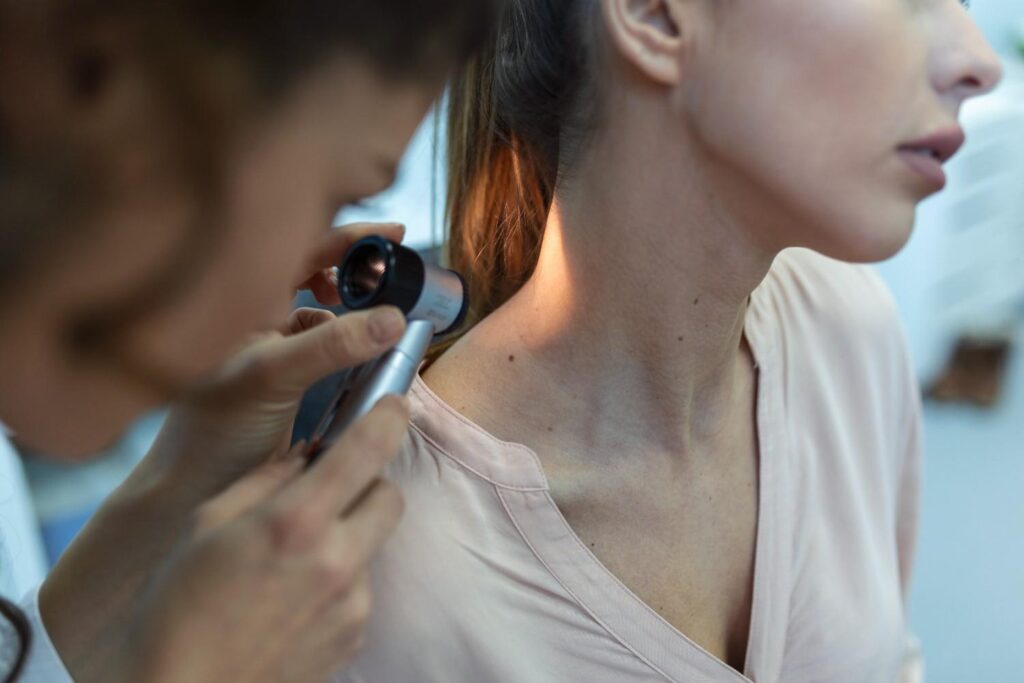
The Dermatology Department at American Hospital Clinics Doha offers comprehensive skin cancer screening and management services. The team uses advanced procedure (a technique for detailed examination of skin lesions) and mole mapping to identify suspicious lesions that may not be obvious to the naked eye. Services include full-body skin cancer screening, assessment and management of suspicious moles and lesions, diagnosis and treatment of actinic keratoses and precancerous conditions, biopsy and pathology where required, personalised sun protection and skin cancer prevention guidance, and follow-up monitoring for patients at elevated risk.
Early detection saves lives. A skin check at American Hospital Clinics Doha is one of the most important preventive healthcare steps you can take as a resident of Qatar.
Myth vs Fact
Myth: Only fair-skinned people get skin cancer.
Fact: All skin tones can develop skin cancer. While melanin provides some protection, it does not eliminate UV-related DNA damage. Skin cancers in people with darker skin are often diagnosed at a later, more dangerous stage.
Myth: Skin cancer is always obvious — you would notice it easily.
Fact: Early skin cancers can be very small, subtle in colour, and easily mistaken for a harmless blemish. Professional dermatoscopy detects lesions that are invisible or ambiguous to the naked eye.
Myth: Skin cancer found on the body is not as serious as internal cancers.
Fact: Melanoma, if not caught early, can spread to the lymph nodes, lungs, brain, and other organs — making it as serious as many internal cancers. Early detection is critical.
Myth: Using sunscreen occasionally when I remember is good enough.
Fact: The protective benefit of sunscreen comes from consistent, daily use. Occasional use provides minimal protection against cumulative UV damage and skin cancer risk.
Myth: There is no point checking my skin if I feel well.
Fact: Early skin cancers typically cause no pain or discomfort. Regular self-examination and professional checks are the only way to detect them before they progress.
What Our Patients Say
— Noura
Frequently Asked Questions
Who should have regular skin cancer screenings in Qatar?
How is a skin cancer screening performed?
Is melanoma treatable if caught early?
Does skin cancer hurt?
Can children develop skin cancer from sun exposure in Qatar?
Conclusion
Skin cancer is preventable, detectable, and treatable—but only if you take it seriously. In Qatar’s extreme UV environment, skin cancer awareness is not optional; it is an important part of protecting your long-term health. Daily sun protection, regular self-examinations, and annual professional skin screenings are among the most effective steps you can take. At American Hospital Clinics Doha, our experienced dermatology specialists are committed to helping you detect skin changes early and reduce your risk through comprehensive skin care and preventive screenings.
Whether you need a routine skin examination, have noticed a new or changing mole, or simply want expert advice on protecting your skin, American Hospital Clinics Doha is here to help. Book your appointment today for personalised dermatology care and peace of mind.
Book your skin cancer screening
Protect your skin with trusted specialists.
C Ring Road,Al Muntazah St Near Al Andalus Petrol Station, Doha, Qatar